
Pender Parole and Probation
North Carolina uses several forms of community supervision. Probation is a court-ordered sentence or part of a sentence served in the community. Parole is conditional release from prison before an eligible older-law sentence expires. Post-release supervision is the statutory period after prison release but before the maximum term ends. Under G.S. 15A-1368, physical release from prison and final sentence discharge are separate events. A person shown as an Active Probationer/Parolee may be living in Pender County while still subject to North Carolina Department of Adult Correction supervision.
The legal source also differs. A judge imposes probation. The North Carolina Post-Release Supervision and Parole Commission sets or modifies supervision conditions, handles revocation matters, and decides parole for people who remain eligible under older law. Modern Structured Sentencing normally sets prison-release timing by statute and sentence calculation, not by a discretionary parole vote. These distinctions prevent a public status from being read as an unconditional end to the case. They also direct each question to the office with authority to answer it.
| Supervision type | How it begins | What the public record means |
|---|---|---|
| Probation | A court orders community supervision, often instead of or after confinement. | Active status supports current NCDAC supervision, not prison custody. |
| Parole | The Commission conditionally releases an eligible older-law prisoner. | Parole dates and history may appear in the state offender record. |
| Post-release supervision | Statute places a person under supervision after a Structured Sentencing prison term. | Prison confinement ended, but the maximum sentence term has not yet terminated. |
- Discharge
- The formal end of a supervision term or sentence status.
- Absconder
- A person NCDAC identifies as avoiding required supervision contact.
- Revocation
- An official action that can end community placement and return a person to custody.
- Detainer
- A request or hold from another authority that may affect custody or movement.
Verify Pender Post-Release Supervision
The main public route is the NCDAC Offender Public Information search, often called OPI. It includes state prison offenders, probationers, and parolees, but it does not cover an ordinary Pender County Jail stay by itself. The search offers status, name, a sounds-like surname option, offender number, sex, race, ethnic group, birth date, and age range. Start with few fields. All supplied values must match, so too many details can hide a valid record.
Identity comes first. An offender number is more reliable than a common name, and leading zeros are not needed. When no number is known, use a surname and part of the first name, then add birth data if results are broad. A matching Active Probationer/Parolee status supports present community supervision. An Inactive result can hold older parole begin and end dates or a completed term. Review all sentence and supervision entries because one expired service row does not cancel another active matter.
- Open OPI and select Active Probationer/Parolee when current Pender County supervision is the question. Select All if status is uncertain.
- Search by offender number when possible. Otherwise use a partial name and add birth data only as needed to narrow matches.
- Open the detail record and confirm the offender number, birth information, conviction county, and supervision history.
- Check Inactive records when older-law parole or a finished supervision term is plausible. Read parole begin, end, and sentence service fields together.
- Use the live state office directory for permissible confirmation when a public field remains unclear. Do not expect confidential case notes or risk material.
Keep the custody boundary clear with Pender sources. The sheriff-linked jail portal concerns county custody, the Jail Division documents local movements, and the Pender County court record can show probation or the judgment. None replaces NCDAC's current supervision status.
Note: A Pender jail custody number and a permanent NCDAC offender number are different identifiers and should never be treated as interchangeable.
Pender Supervision Office Channels
Community Supervision has four judicial divisions and 30 districts, with offices serving every North Carolina county. A field roster dated September 11, 2025 places Pender and New Hanover counties in Judicial District 5. Because assignments, staff, and sites can change, the live Community Supervision directory should be checked before a visit. The dated roster is useful evidence for the district contact, but it is not a permanent staffing promise.
The office may confirm public or permissible status details, yet most supervision file content is confidential under G.S. 15-207. Public access should not be expected for officer notes, assessments, personal addresses, or a complete list of conditions. An interstate transfer can also move day-to-day supervision outside Pender without ending the North Carolina case.
Community Supervision, Judicial District 5
721 Market Street, Suite 102
Wilmington, NC 28401
District: 910-251-2701
State Community Supervision: 919-716-3100
Dated field-roster placement: September 11, 2025. Confirm through the live directory before visiting.
The official district directory shows how North Carolina routes Pender County supervision. The captured directory provides a visual checkpoint for the office channel described above.
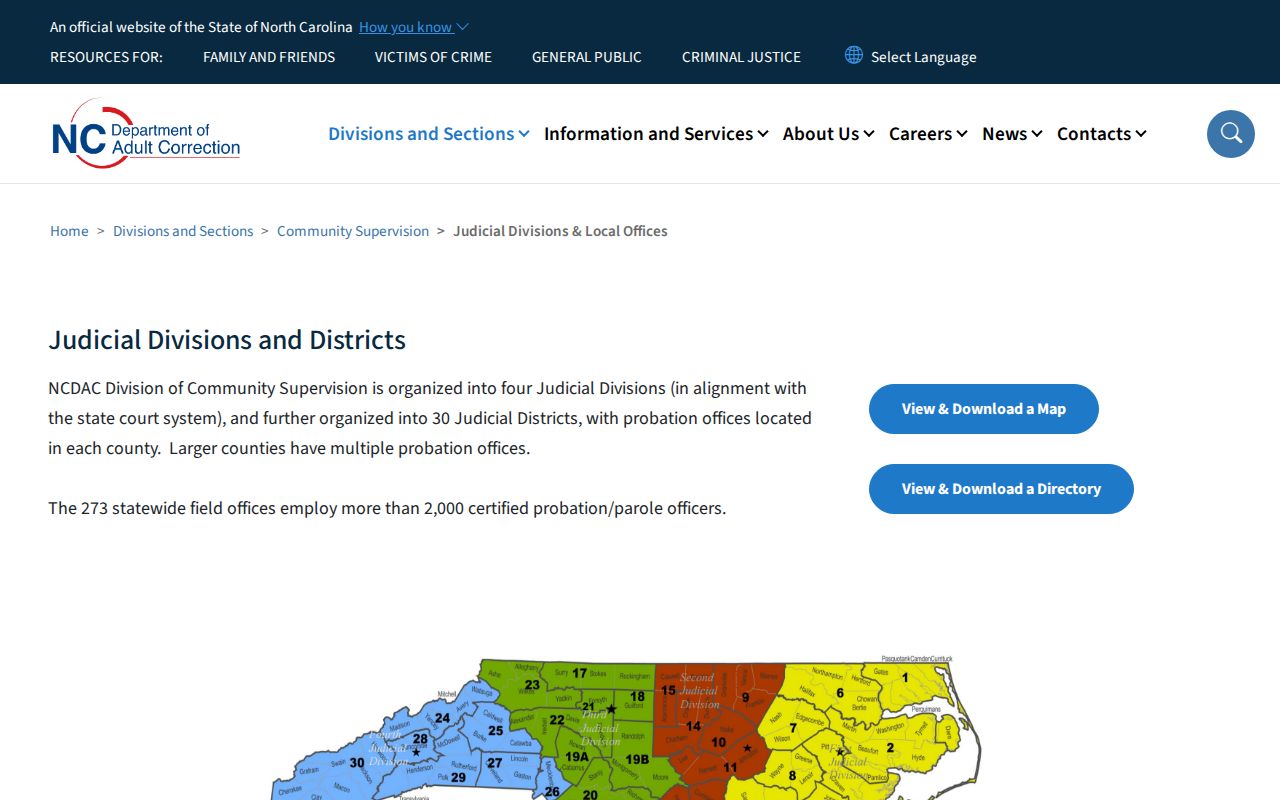
This state source should be consulted again when a dated roster and current contact information differ.
Pender Probation Absconder Status
A missing supervision contact does not automatically prove custody. For a possible absconder, use the official Absconded Probationer Search with surname and county of supervision. An absconder label means NCDAC identifies the person as avoiding supervision. It is not a new conviction. Nor does the label, by itself, show that the person has been arrested or returned to prison.
Read an absconder result beside OPI and any later court or custody record. A violation can lead to a hearing, modified conditions, or revocation, but the outcome is not safe to infer from the search label. NC SAVAN can send some supervision-event notices, including absconding, capture, termination, discharge, or death when covered. Those alerts are useful signals. The official record and the supervising authority remain the better confirmation of what happened next.
Pender Parole Review Records
North Carolina does not operate a conventional public parole hearing calendar. Commissioners generally review files and vote on their own rather than meeting as a group for a formal hearing. An eligible person usually does not file an application or appear at a face-to-face proceeding. The Commission's parole-process explanation is the official substitute for assumptions about a courtroom-style calendar.
The captured state explanation shows why no ordinary hearing date should be invented for a Pender County case.
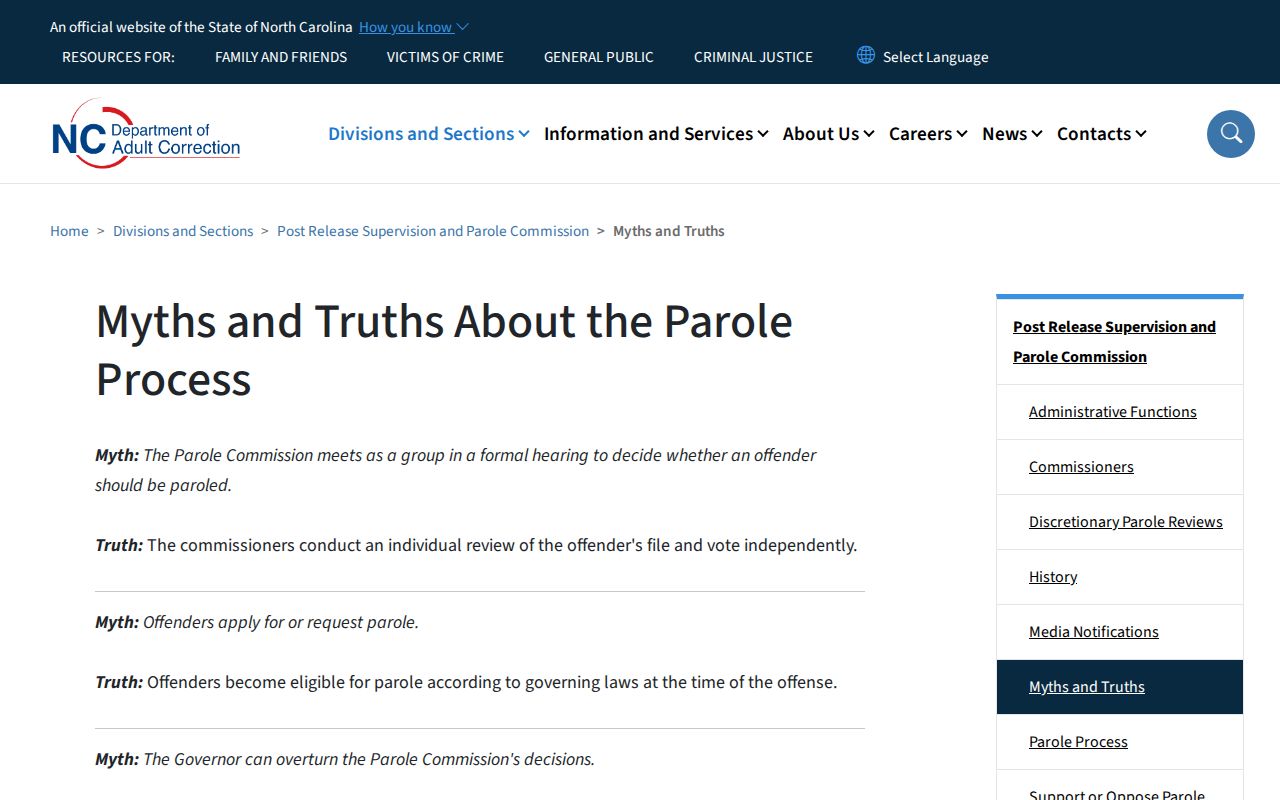
That process differs from statutory post-release supervision, which normally follows modern Structured Sentencing calculations.
The public decisions channel is the Commission's monthly Discretionary Parole Reviews. Research found reports beginning in September 2024 and running through June 2026. Most eligible cases are reviewed at least once a year, while first- or second-degree murder cases may be reviewed every three years and sexually violent offenses every two years. These intervals are review cadence, not scheduled docket dates.
Official labels matter. An “Incomplete Decision” can mean more information is needed. “Suspend Decision” stops consideration at that point. Other categories include regular parole, community-service parole, early medical release, and 90-day mandatory parole. None should be reduced to a generic grant or denial without reading the report. Crimes before October 1, 1994 may remain parole eligible, while later Structured Sentencing crimes generally are not, subject to limited exceptions.
Note: Monthly parole-review reports are the public results channel, but they do not reveal every confidential Commission record or create a hearing calendar.
Pender Parole Commission Contact
The North Carolina Post-Release Supervision and Parole Commission sets supervision conditions and handles modification, revocation, and eligible parole matters. Under Structured Sentencing it generally does not select the statutory prison-release date. A question about the arithmetic of a state sentence belongs with NCDAC sentence and release channels, while a question about a Commission action belongs with the Commission.
Post-Release Supervision and Parole Commission
2020 Yonkers Road
4222 Mail Service Center
Raleigh, NC 27699-4222
919-716-3010
parole.commission@dac.nc.gov
The Commission's administrative functions explain its authority. For a released Pender County person, first identify whether the record shows probation, older-law parole, or post-release supervision. That choice determines which office and record can answer the question.
Pender Supervision and Discharge
Supervision ends through an authorized discharge or sentence termination, not because a name is absent from one screen. OPI may show a parole end date, an inactive overall status, or an expired sentence row. Each layer answers a different question. “EXPIRED” beside one sentence means that service entry ended. Overall Inactive status is stronger evidence that no current NCDAC prison or supervision activity remains, but every listed sentence and supervision event still needs review.
NC SAVAN may report supervision termination, discharge, or death within program coverage. It does not replace the underlying NCDAC record, and it does not provide parole-review notice. A person whose supervision moved through the Interstate Compact may no longer report to a Pender office while the North Carolina matter remains active. When exact completion matters, match OPI history with permissible confirmation from Community Supervision or the Commission.
The broader Pender County released-inmate search and release-record path helps separate a jail release, a state-prison exit, and the end of supervision. That distinction is crucial: community presence can begin before the maximum sentence terminates, while discharge marks the later end of the supervision status. Check every active entry before concluding.